
Home > PVD/PACVD coatings
HEF’s CERTESS™ technologies consist of environmentally friendly (zero impact) coatings with high surface hardness (up to 3000 HV) that are deposited on the surfaces of various types of materials, mainly cemented carbide. This deposition occurs via PVD/PACVD (Physical Vapor Deposition/Plasma Activated Chemical Vapor Deposition) processes, resulting in thin layers a few µm thick (between 2µm and 5µm). Despite being relatively thin, these layers, when correctly combined with the substrate, provide a significant gain in tribological performance of the coated parts.
In principle, these processes reproduce the surface finish of the substrate; therefore, their application presupposes that the part to be coated has its final dimensions and finish, with the coating being the last operation in the manufacturing process.
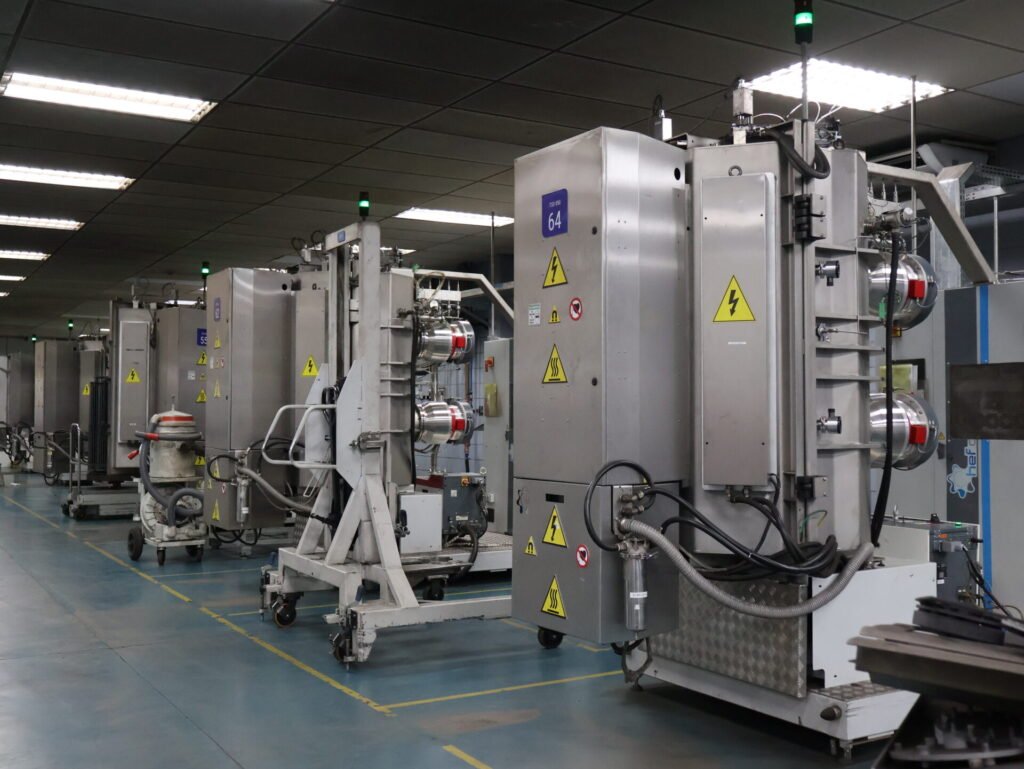
Specifically in the PACVD process, there is a sequential combination of PVD and CVD processes within a vacuum chamber. In PVD, the material to be deposited is initially vaporized and ionized, forming a plasma. Due to the potential difference, the ions, in pure form or combined with nitrogen and/or carbon atoms, are attracted to the surface of the parts to be coated. Additionally, CVD occurs, where the element to be deposited, via plasma, comes from the decomposition of a gas through a chemical reaction. The layer material condenses on the surface of the parts being coated.
HEF has been developing and innovating in the field of PVD-PECVD and PVD technology for over 50 years and, due to its mastery of the process, has developed a series of coatings, such as CERTESS™ CARBON and CERTESS™ NITRO, which cover a wide range of applications, providing properties such as increased wear resistance, reduced friction and increased service life of mechanical components.
CERTESS™ CARBON – DLC
With the PACVD technique, an important family of coatings can be produced: DLC (Diamond-Like Carbon) layers. It is an amorphous carbon structure represented by the symbol a-C:H, which may contain some fraction of metallic elements, such as W, Ti, and Si, depending on the required properties.
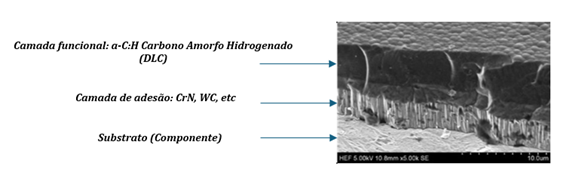
To improve the adhesion of DLC layers, an intermediate layer is usually applied between the substrate and the DLC, also called an adhesion layer. This layer can be composed of a metallic element (e.g., Cr), a metallic nitride (e.g., CrN), a metallic carbide (e.g., WC, WCC), or a combination of all three. The micrograph below shows this layered structure:
DLC layers can be seen as an intermediate compound between carbon in the form of graphite and carbon in the form of diamond. Depending on the coating process conditions, it is possible to regulate the hardness (up to 3000 HV), roughness, and lubricity of the layer, thus combining in a single product the sliding characteristic of graphite (very low coefficient of friction and low tendency to seize) with the high hardness of diamond. In addition to these characteristics, the sophisticated aesthetic finish and low-temperature deposition (down to 200°C) make DLC an alternative for complex, high-performance parts.
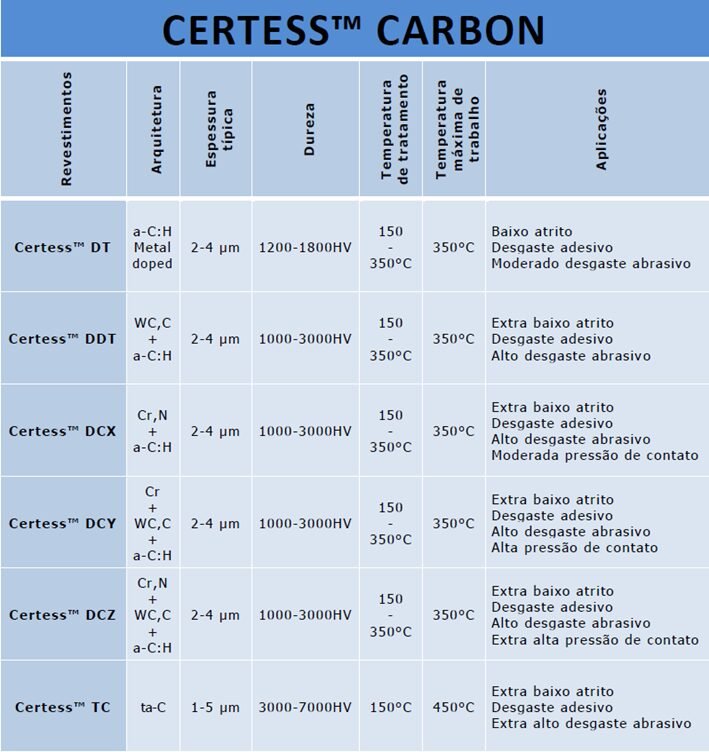
The table below shows some examples of DLC coatings for precision mechanical components. The thickness and hardness values are adjusted according to the application, and the table shows typical usage ranges.
Main components treated with CERTESS™ CARBON technology: piston pins, valve lifters, injection system components, air conditioning compressor vanes, plastic injection molds.
For more information on all types of CERTESS™ coatings, click and access our Datasheet: