
Development and innovation at HEF: Pioneer in advanced technologies
Austempered ductile iron, identified by the acronym ADI, is a class of materials that is increasingly being explored by designers and engineers due to its excellent and unusual combination of mechanical strength and toughness. The good balance between some seemingly antagonistic properties, such as tensile strength and elongation, is opening up possibilities for these materials in applications historically served by components made from hardened, forged, or welded materials, ferrous or non-ferrous, with benefits that also include a significant reduction in component weight and excellent resistance to wear and fatigue.
With its initial records of commercial use dating back to the early 1970s, it was in recent decades that ADIs (Automotive Induction Devices) gained more space in a wide variety of industrial applications, particularly those related to the automotive segment, which continuously expends efforts and resources in the search for lighter materials that provide greater energy efficiency, such as in the production of crankshafts, gears, wheel hubs, suspension components, among others.
To understand why these materials exhibit the characteristics observed, we must look more closely at their microstructural morphology. Unlike what is normally observed in materials subjected to austempering treatment, where a predominantly bainitic microstructure is evident, in ADI materials a microstructure called ausferrite is observed, composed essentially of acicular ferrite and high-carbon stabilized austenite, in addition to the ever-present graphite nodules.
Considering the fulfillment of premises related to the production process of the raw casting, involving the minimization of defects in the die, a minimum degree of nodularization, and the dispersion of graphite nodules, ausferrite can be obtained within a specific time interval called the process window, within the isothermal plateau of austempering, as we can observe in Figure 1.
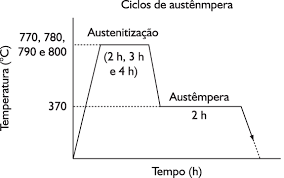
In basic terms, we can describe the austempering treatment shown in Figure 1 as follows:
Stage 1 – Heating and maintaining the material at austenitizing temperature until complete homogenization, typically between 830º and 950ºC.
Stage 2 – Rapid cooling, usually carried out in molten salt baths, in order to prevent the decomposition of austenite into pearlite, to a temperature above the temperature at which the martensitic transformation begins.
Stage 3 – Holding at austempering temperature, typically between 230ºC and 400ºC. This stage is divided into two steps. The first consists of the nucleation of acicular ferrite platelets at the graphite/austenite interfaces and grain boundaries, separated by layers of austenite stabilized with carbon supplied by the ferrite. The second step involves the decomposition of the enriched austenite into acicular ferrite and carbides, a structure known as bainite. This is followed by air cooling.
The highly sought-after ausferritic microstructure, responsible for giving nodular cast irons their unique physical properties, is formed in a time interval located in Stage 3, between the end of stage 1 – Nucleation of ferritic platelets and the beginning of stage 2 – Beginning of bainite formation.